


„With the Econik 1851, I have created a loudspeaker that combines sculptural clarity, German engineering and uncompromising sound precision in a single, timeless object.“ - Anton Erbenich
„With the Econik 1851, I have created a loudspeaker that combines sculptural clarity, German engineering and uncompromising sound precision in a single, timeless object.“ - Anton Erbenich


The Econik 1851 is a fully active high-end designer loudspeaker system that combines sculptural aesthetics with state-of-the-art audio technology. Its 3D-printed quartz sand enclosure provides an exceptionally rigid and low-resonance base for maximum sound precision. High-quality ceramic drivers from Eton Audio and the integrated WiSA-enabled electronics module ensure impressive dynamics, transparency and wireless freedom. Developed and manufactured in Germany, the Econik 1851 stands for uncompromising quality and a new form of audiophile design culture.
The Econik 1851 is a fully active high-end designer loudspeaker system that combines sculptural aesthetics with state-of-the-art audio technology. Its 3D-printed quartz sand enclosure provides an exceptionally rigid and low-resonance base for maximum sound precision. High-quality ceramic drivers from Eton Audio and the integrated WiSA-enabled electronics module ensure impressive dynamics, transparency and wireless freedom. Developed and manufactured in Germany, the Econik 1851 stands for uncompromising quality and a new form of audiophile design culture.





High-end drivers from Eton: ceramic precision – made in Germany
At the heart of the Econik 1851 are specially selected ceramic drivers from German manufacturer Eton Audio, renowned for their extremely rigid, low-resonance diaphragms and the highest manufacturing precision. The ceramic-coated membranes have an exceptionally high stiffness-to-weight ratio and behave almost like pistons even at high levels. This results in minimal distortion, enormous detail resolution and exceptionally clean transient reproduction.
Each driver is manufactured in Germany, individually measured and then precisely tuned to the quartz sand enclosure and spherical interior geometry via the integrated DSP. The precise connection between high, mid and low frequencies is active and phase-optimised. The result is a high-resolution, impulse-accurate sound image with impressive neutrality – a driver system that consistently underlines the technical maturity and audiophile standards of the Econik 1851.
High-end drivers from Eton: ceramic precision – made in Germany
At the heart of the Econik 1851 are specially selected ceramic drivers from German manufacturer Eton Audio, renowned for their extremely rigid, low-resonance diaphragms and the highest manufacturing precision. The ceramic-coated membranes have an exceptionally high stiffness-to-weight ratio and behave almost like pistons even at high levels. This results in minimal distortion, enormous detail resolution and exceptionally clean transient reproduction.
Each driver is manufactured in Germany, individually measured and then precisely tuned to the quartz sand enclosure and spherical interior geometry via the integrated DSP. The precise connection between high, mid and low frequencies is active and phase-optimised. The result is a high-resolution, impulse-accurate sound image with impressive neutrality – a driver system that consistently underlines the technical maturity and audiophile standards of the Econik 1851.
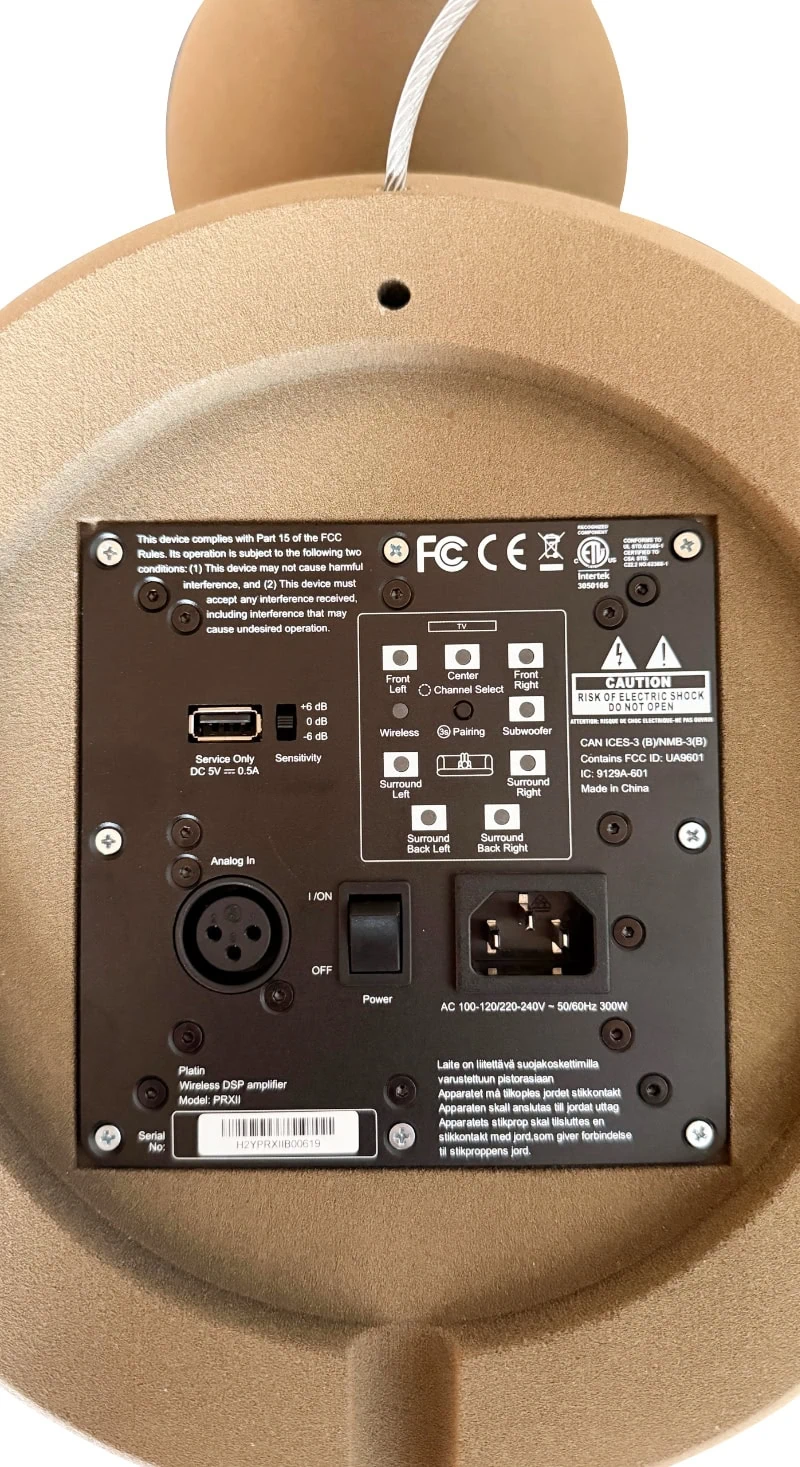
Minimalist setup: fully active system with wireless transmission
As an active high-end system, the Econik 1851 integrates all amplifiers, DSP units and signal processing stages directly into the cabinet. The signal path is precisely matched to the cabinet volume and the chassis used, resulting in a particularly controlled frequency response and precisely tuned transitions.
The Econik 1851 operates completely wirelessly via WiSA. The system receives high-resolution audio signals with low latency and no interference – ideal for minimalist setups without visible players.
Thanks to the fully internal electronics, a single power cable per speaker is sufficient. External amplifiers, receivers or complex cabling are completely unnecessary. The result: maximum reduction, uncompromising signal purity and an extremely tidy living room or studio setup.
Minimalist setup: fully active system with wireless transmission
As an active high-end system, the Econik 1851 integrates all amplifiers, DSP units and signal processing stages directly into the cabinet. The signal path is precisely matched to the cabinet volume and the chassis used, resulting in a particularly controlled frequency response and precisely tuned transitions.
The Econik 1851 operates completely wirelessly via WiSA. The system receives high-resolution audio signals with low latency and no interference – ideal for minimalist setups without visible players.
Thanks to the fully internal electronics, a single power cable per speaker is sufficient. External amplifiers, receivers or complex cabling are completely unnecessary. The result: maximum reduction, uncompromising signal purity and an extremely tidy living room or studio setup.
Minimalist setup: fully active system with wireless transmission
As an active high-end system, the Econik 1851 integrates all amplifiers, DSP units and signal processing stages directly into the cabinet. The signal path is precisely matched to the cabinet volume and the chassis used, resulting in a particularly controlled frequency response and precisely tuned transitions.
The Econik 1851 operates completely wirelessly via WiSA. The system receives high-resolution audio signals with low latency and no interference – ideal for minimalist setups without visible players.
Thanks to the fully internal electronics, a single power cable per speaker is sufficient. External amplifiers, receivers or complex cabling are completely unnecessary. The result: maximum reduction, uncompromising signal purity and an extremely tidy living room or studio setup.

Suspended mounting: steel cable suspension with maximum decoupling
The Econik 1851 is supported by a specially developed steel cable system that makes the solid loudspeaker appear to float. At the same time, the suspension separates the cabinet almost completely from the ground and prevents the transmission of structure-borne noise, which could otherwise distort parts of the low frequency range. The design is passive, maintenance-free and ensures that the full precision of the system reaches the listener unadulterated – regardless of floor construction or room acoustics.
Suspended mounting: steel cable suspension with maximum decoupling
The Econik 1851 is supported by a specially developed steel cable system that makes the solid loudspeaker appear to float. At the same time, the suspension separates the cabinet almost completely from the ground and prevents the transmission of structure-borne noise, which could otherwise distort parts of the low frequency range. The design is passive, maintenance-free and ensures that the full precision of the system reaches the listener unadulterated – regardless of floor construction or room acoustics.
Optimised sound geometry: monolithic outer shape, spherical inner volume
The outer shape was deliberately kept clear, geometric and sculptural, while the interior works with an almost spherical volume. This geometry reduces standing waves, lowers internal pressure reflections and ensures controlled, precise radiation from the actively controlled drivers. The material thickness and wall structure were optimised for minimal resonance transfer values using FEM simulation – a decisive advantage over conventional wood and plastic constructions.

Optimised sound geometry: monolithic outer shape, spherical inner volume
The outer shape was deliberately kept clear, geometric and sculptural, while the interior works with an almost spherical volume. This geometry reduces standing waves, lowers internal pressure reflections and ensures controlled, precise radiation from the actively controlled drivers. The material thickness and wall structure were optimised for minimal resonance transfer values using FEM simulation – a decisive advantage over conventional wood and plastic constructions.
Optimised sound geometry: monolithic outer shape, spherical inner volume
The outer shape was deliberately kept clear, geometric and sculptural, while the interior works with an almost spherical volume. This geometry reduces standing waves, lowers internal pressure reflections and ensures controlled, precise radiation from the actively controlled drivers. The material thickness and wall structure were optimised for minimal resonance transfer values using FEM simulation – a decisive advantage over conventional wood and plastic constructions.

Design redefined: 3D-printed quartz sand casing
The Econik 1851 enclosure is manufactured entirely from quartz sand using industrial 3D printing and then impregnated with epoxy resin. This creates an extremely stable, monolithic body with exceptionally high internal damping. Quartz sand naturally has very high damping properties; in combination with the epoxy resin, even the finest micro-vibrations are effectively absorbed, which classic MDF or aluminium enclosures can only control with considerable additional design effort. The mineral, open-pored surface is created directly during the manufacturing process and is not a subsequent finish – each enclosure fulfils a precisely defined acoustic function.
Design redefined: 3D-printed quartz sand casing
The Econik 1851 enclosure is manufactured entirely from quartz sand using industrial 3D printing and then impregnated with epoxy resin. This creates an extremely stable, monolithic body with exceptionally high internal damping. Quartz sand naturally has very high damping properties; in combination with the epoxy resin, even the finest micro-vibrations are effectively absorbed, which classic MDF or aluminium enclosures can only control with considerable additional design effort. The mineral, open-pored surface is created directly during the manufacturing process and is not a subsequent finish – each enclosure fulfils a precisely defined acoustic function.
More than just one choice


Discover the technology behind the Econik 1851: In the following sections, you will find detailed information about the design, drivers, electronics, materials and our development approach. Delve deeper into the technology that makes this loudspeaker unique.
Ceramic tweeters from Eton Audio
The Econik 1851 tweeter uses a high-precision ceramic system from Eton, a manufacturer that has been renowned for many years for its exceptional material expertise and particularly low-distortion high-frequency reproduction. The extremely rigid yet sensitive ceramic dome enables impressively clear reproduction of the finest details and guarantees exceptional resolution across the entire upper frequency range.
The high internal damping of the ceramic composite material effectively suppresses unwanted partial vibrations, resulting in a silky-clear, unadulterated sound image. The precisely tuned motor system contributes to a very low distortion structure and ensures exceptional impulse fidelity – even with demanding music passages and high levels.
The tweeter fits perfectly into the overall design of the Econik 1851 and offers brilliant, detailed high-frequency reproduction that impressively combines analytical clarity with musical smoothness.
Low-midrange speaker from the Arcosia series by Eton Audio
The low-midrange driver in the Econik 1851 comes from Eton's renowned Arcosia series and represents high-end engineering "Made in Germany". The characteristic Arcosia cone, made from a specially hardened composite material, combines high rigidity with excellent internal damping. This results in extremely clean, controlled decay and ensures neutral, precise reproduction in the crucial bass and midrange frequencies.
The carefully designed magnet system enables dynamic, differentiated reproduction of even the smallest changes in volume. The entire chassis design is geared towards high resilience, fast impulse processing and extremely linear performance – characteristics that offer audible advantages, particularly with complex music and high volumes.
Combined with the precise tuning of the Econik 1851, this results in a sound image of exceptional naturalness and clarity: voices come across authentically, instruments retain their characteristic structure, and the transition to the high frequency range is seamless and harmonious.
WiSA (Wireless Speaker and Audio Association) technology is at the forefront of the audiophile revolution, taking wireless high-resolution audio transmission to a new level. With the ability to support surround sound systems up to 7.1 configurations, including immersive 3D sound, WiSA opens up new dimensions in the listening experience. The unique feature of WiSA is its manufacturer independence, which allows devices from different brands to be seamlessly connected with each other. This interoperability ensures flexible system configuration and expansion, tailored to the individual preferences and requirements of users.
Flexibilität in der Platzierung
WiSA wireless transmission technology offers unparalleled freedom in speaker placement. Without the constraints of cables that need to be laid and hidden, Econik 1851 can be positioned anywhere in the room to create the best possible listening experience. This flexibility makes it easy to integrate the speakers into any room concept and interior design, allowing you to design your music system or home cinema exactly the way you want it.
Future-proof technology
Through its ongoing development and improvement of transmission standards, WiSA is establishing itself as a future-proof technology. Owners of Econik speakers can rest assured that their systems will continue to meet the highest audiophile standards. Continuous innovation in the field of wireless audio transmission promises long-term compatibility and performance that meets the demands of modern audiophiles.
Highest signal purity and integrity
One of the key advantages of WiSA technology is its ability to transmit audio signals with a resolution of 24 bits and a sampling rate of 96 kHz, ensuring unrivalled sound quality. Unlike traditional wired systems, where signal quality can be compromised by resistance in the cables, wireless transmission ensures pure and unadulterated reproduction that is every bit as good as the original.
Minimisation of internal signal paths
The Econik 1851 features internally minimal speaker cables to minimise any losses and maximise efficiency. This internal design decision, combined with wireless transmission, ensures that the audio signal is routed directly to the speaker chassis with minimal interference. The result is exceptional fidelity and dynamics that are difficult to achieve in traditional systems.
At the heart of the outstanding sound experience offered by the Econik 1851 lies advanced technology that goes far beyond traditional audio concepts: the digital crossover. This innovative component is the heart of our loudspeakers and is responsible for the exceptional clarity and precision they deliver. By using specialised digital filters, in particular Finite Impulse Response (FIR) filters, the digital crossover achieves a level of detail and sound quality that previously seemed unattainable.
Precise frequency separation and optimal chassis control
The digital crossover separates the incoming audio signal into different frequency bands, each optimised for driving specific drivers, such as woofers, midrange drivers and tweeters. This separation allows each driver to reproduce only the frequencies for which it was designed, resulting in a significant reduction in distortion and an improvement in overall sound quality.
Thanks to digital processing, we can achieve a level of precision in frequency separation that is not possible in analogue systems. The digital crossover allows for extremely fine and precise adjustment of the filter characteristics, so that the transitions between the drivers are seamless and without audible discontinuities. This results in perfect harmony between the drivers, with each element of the audio spectrum reproduced with optimum efficiency and coherence.
The soul of active loudspeakers: the digital crossover in practice
A key feature of the digital crossover is its ability to control the time delay between the drivers to within a fraction of a millisecond. This precise timing ensures that the sound waves from each driver arrive at the listener synchronously, which is essential for maintaining phase coherence and creating a spatially accurate and three-dimensional sound image.
The digital crossover is therefore more than just a technical component; it is the soul of active loudspeakers, opening up a new dimension in sound fidelity. With its help, we achieve sound reproduction that sets new standards in terms of both precision and naturalness.
Overcoming phase problems through advanced digital signal processing
In the Econik 1851, we have overcome these challenges through the use of advanced digital signal processing. Our specialised digital crossovers enable accurate phase control that far exceeds the capabilities of passive systems. Precise digital algorithms allow us to ensure that the phases of the sound waves from each driver – whether it's the tweeter, midrange or woofer – are perfectly aligned.
This precise phase alignment is crucial because it allows the sound waves to combine into a harmonious whole instead of cancelling each other out or interfering with each other. Phase coherence is particularly important in the transition frequencies, where the acoustic contributions of the various drivers should blend seamlessly. In passive loudspeakers, poor phase alignment can result in an unclear sound image, as sounds no longer reach the listener at the same time. This can impair the sound stage and the localisation of sound sources, ultimately diminishing the overall listening experience.
The importance of precise phase alignment for a harmonious and detailed sound image
The Econik 1851, on the other hand, uses digital precision to overcome phase problems. The result is a coherent and integrated sound image that is so detailed and lifelike that it is as if you were sitting in the front row of a concert. With our technology, every musical detail is reproduced with extreme precision and without time delay, which is an unattainable luxury in passive technology. Phase coherence is therefore not just a technical specification, but the key to a natural, immersive and emotionally touching listening experience.
Digital purity: A new era without analogue components in the signal path
There are essentially two different approaches or philosophies for passive loudspeaker systems:
-
The first variant involves the use of many components to achieve a uniform frequency response. However, this complexity inevitably leads to undesirable side effects. Phase shifts and delays in the sound definitely occur, which makes the music sound unnatural and impairs playback.
-
Alternatively, a reduced number of components can be used in the signal path to minimise interference. However, this simplification inevitably leads to uneven sound, as not all frequencies are reproduced equally loudly by the chassis.
Our innovative technology goes beyond these traditional approaches. With our digital crossover, we not only achieve an even more linear frequency response compared to passive systems, but also completely avoid disruptive analogue components in the signal path. The result is a clear, precise and natural sound that combines the best of both worlds and takes the listening experience to a new level.
Here you will find various WiSA-enabled devices that transmit the digital radio signal reliably and losslessly to the Econik 1851. Explore the options and choose the preamplifier that best suits your setup.
Control via app.
App for iOS
& Android (shortly)

The Econik app is available for iOS and Android users (coming soon) and can be downloaded for free from the respective app store. As soon as you open the app, it automatically detects the Stereo Hub in your network. This enables a convenient and seamless connection between your device and the Stereo Hub. All you have to do is start the app and you can access the functions and settings directly.
Control
options

On the home screen of the Econik app, you will find a clear interface with various control elements. Here you can select the input source of the hub, adjust the volume, change songs during streaming and pause or resume playback. These functions allow you to intuitively control your system directly from your mobile device.
Speaker
configuration

The app allows you to make basic system settings. You can set individual volume levels, crossover frequencies (when using a subwoofer) and listening distances for each speaker. You can also assign the speakers to the corresponding channels in the WiSA system, which ensures individual adjustment and optimum sound quality.
Room EQ (Automatic Calibration)

The Econik app offers automatic calibration of the low frequency range to eliminate annoying drone. You can use either your iPhone or the optional Zen Wireless Microphone to measure the current state. A special algorithm then calculates the optimum bass level for your listening position and saves the correction file on the Stereo Hub. This means that the bass correction is activated even when the app is not running.
Manual DSP
(Manual EQ)

By using the manual DSP, you can fully customize the sound of your Econik speakers by individually adjusting parametric EQs and high and low pass filters. You have full control over the filter parameters, including frequency, bandwidth (Q) and gain (dB). The settings you make can be saved in three different presets, allowing you to recall the optimum sound for different applications.
App for iOS &
Android (shortly)
The Econik app is available free of charge for iOS and Android (coming soon). As soon as you start the app, it automatically recognizes the Stereo Hub in your network. This enables a quick connection and gives you immediate access to a wide range of functions and settings for your system.
Control
options
The app offers a clear interface with controls on the home screen. There you can select the input source, adjust the volume and change songs during streaming as well as pause or resume playback. This gives you intuitive control from your mobile device.
Speaker
configuration
The app enables individual system settings such as volume levels, crossover frequencies (when using a subwoofer) and listening distances for each speaker. You can also assign the speakers to the corresponding channels in the WiSA system, which ensures optimum sound quality.
Room EQ
(Calibration)
The app offers automatic calibration of the low frequency range to eliminate drone. You use either your iPhone or the optional Zen microphone for the measurement. A special algorithm then calculates the optimum bass level and saves the correction on the hub for permanent bass optimization.
Manual DSP
(Manual EQ)
With the app's manual DSP, you can customize the sound with parametric EQs and high and low pass filters. You have full control over frequency, bandwidth and gain. The results can be saved in three different presets to retrieve the optimum sound for different applications.
Stereo Hub and Surround Hub offer two options for sound correction: an automatic calibration system and manual EQ settings. These functions can be used independently or in combination to achieve customised sound optimisation.
Automatic calibration for perfect bass
The calibration system uses advanced algorithms to automatically analyse and adjust the bass range of your room. Targeted correction below 500 Hz makes the bass more precise, controlled and free of unwanted resonances or overemphasis that can be caused by room acoustics. The result is clean, tight bass that forms the basis for a clear and detailed overall presentation. This selective calibration process ensures that the room acoustics are precisely corrected where it is most needed without compromising the sound quality in the mid and high frequencies. This preserves headroom and does not restrict dynamics, which is particularly important at higher frequencies.
Manual EQ settings for individual preferences
The manual EQ settings allow you to customise the sound completely to your liking. With a selection of parametric, low-pass, high-pass, high-shelf and low-shelf filters, you can target specific frequency ranges. These settings allow you to change the sound character of your speaker and tailor it perfectly to your listening habits.
Three memory slots for individual manual settings
To further increase flexibility, you can save up to three different EQ configurations in presets. This allows you to quickly and easily switch between different sound profiles depending on what you are listening to or the mood you want to create. Whether for an intimate jazz concert, a dynamic film scene or relaxed background music, the storable EQ presets allow you to adjust the sound in no time at all.
Our Values.
Carl-Benz-Str. 5
Baden-Württemberg
Sulzfeld, Deutschland, 75056
info@econik-speakers.com
https://econik-speakers.com/